Monday, March 14, 2016

War, huh yeah. What is it good for? Absolutely nothing.


But we can be grateful
And thankful and proud
That man's been endowed 
With a mushroom shaped cloud 
And we know for certain that
Some lovely day someone will set the spark off
And we will all be blown away 
They're rioting in Africa
There's strife in Iran
What nature doesn't do to us will be done by our fellow man
Kingston Trio, Merry Minuet


And now it seems to me the beautiful uncut hair of graves.
Tenderly will I use you curling grass,
It may be you transpire from the breasts of young men,
It may be if I had known them I would have loved them;
It may be you are from old people and from women, and
from offspring taken soon out of their mother’s laps,
And here you are the mother’s laps.
This grass is very dark to be from the white heads of old
mothers,
Darker than the colorless beards of old men,
Dark to come from under the faint red roofs of mouths.
O I perceive after all so many uttering tongues!

Walt Whitman,  Leaves of Grass.  
Whitman nursed the fatally-injured  in the US Civil War.
He knew about War.


"Thursday night’s Republican debate at the University of Miami revealed one startling thing: all four Republican candidates for president would put more boots on the ground to fight ISIS.

"CNN debate moderator Hugh Hewitt during the debate asked candidates whether they would put troops on the ground “to end the ISIS threat in Syria and Iraq,” and every candidate on stage said he would.


""Perhaps the most shocking commitment came from Donald Trump who said he would do so, even if 20,000 or 30,000 troops were needed.

'I would listen to the generals, but I’m hearing numbers of 20,000 to 30,000,' Trump said. 'We don’t fight like we used to fight. We used to fight to win. Now we fight for no reason whatsoever. We don’t even know what we’re doing. So, the answer is we have to knock them out. We have to knock them out fast.'"A Republican President Means American Boots On The Ground In The Middle East – Again | ThinkProgress  [Thanks, Rik!]

Some 620,000 United States soldiers were killed the Civil War; more than 407,000 United States soldiers were killed in WWII.  

Human beings killed abut 60 million of our kith an kin during WWII, but that's only abut 3% of the World's population in 1940.  World War II casualties - Wikipedia.   Three percent hardly made a dint in our total population, which has swelled 7.4 billion today; 

but it made a lot of folks heart-sick, angry, uncomfortable with their lot, and thrusting for revenge.  

It's those at home thrusting for revenge, even even those who have no injury to atone for, who are a cause of the world's troubles.  The dead don't trouble anyone.

In the  71 years since WWII, the United States has been in a War against someone almost all the time and we mostly lost them:
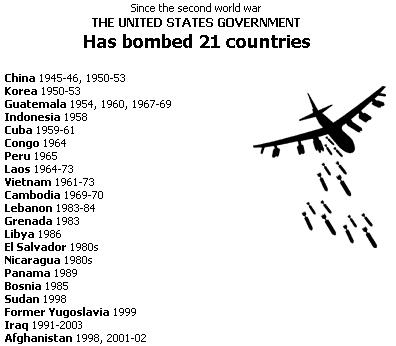

This list ends in 2012.  Syria, Iraq again, and various North African and Sub-Saran African nations must be added.


Some United States' Wars have been big; some small.   

President Reagan the Lion-Hearted 
who hated Communism but was afraid to bomb the commies in the 
Soviet Union because 
it was as strong as he,
retted that he would miss out on a War until Mighty Grenada challenged him:


He Won!  He Won!! We finally Won a War!  Reagan the Lion-Hearted is the darling of every Republican today. 


Oh noble We   . . surely a War to swell with pride the breasts of true Patriots  when thoughts turn to days of Glory.

. . . So a Trumpian 20,000 or 30,000 dead in Iraq, after 4,500 already killed there, is diminishingly small, compared to the whole of the human family.


Still. . . . 


War does leave lots of folks angry, vengeful.  


More than 27,000 civilians 
were killed in Bushco's Iraq Fiasco, and a couple of million folks 
are still  homeless  
in Turkey and Jordan
 or  
in their own homeland.  
All of them, 
and their sisters and their cousins and their aunts, 
and all their kith and din, 
who knows how far their pain reaches, or for how many hears, 
folks worldwide, 
for at least seven generations, 
who are already angry 
with the United States 
and thirst for revenge.

If the United States invades again-- even though the cause be thought to be just -- the "unintended consequences" which we can no longer think of as unintended because we know the dreadful consequences, [see his blog, here
won't add much to the anger already directed at the United States and won't add much to the antiUnited States  
 Saudi Arabia Wahhabist faith which is shared by the SunnyArab Islamic State.


That added rage 

should be enough, though
to keep the United States' War factories  
and Dick Cheney and his 
neoconic friends 
rolling in lucre, 
which they 
invested unproductively 
in Abu Dubai, the capital of the sandy the United Arab Emirates,
(which needs water more than lucre,

Abu Dubai as a sandstorm approaches) . . .

. . . rolling in ulcer  for a another decade or so.  


Or else the United States 
will not elect 
a Warmonger 
to its presidency. 

The World's already 
bounteous rage 
would not not increase-- 

a modest
but unmitigated
blessing. 

Here are some political cartoons not in order, commenting on some of the United States' wars.  
Some of you will like them; 
Some of them will offend you as some offend me;
they will enrage easily enraged friends.  

None will change anyone's political stance:


 Fresh, spirited American troops, flushed with victory, are bringing in thousands of hungry, ragged, battle-weary prisoners. News item.jpg


Lubin de Beauvais 1914


 Again


WWII Images from Wikipedia:


We inherit our political stances, 
and therefore 
keep on Waring.  
The challenge is for those of us 
whose ancestors liked War
(Most of Us) 
to enjoy Peace . 
The Hill to climb from War to Peace
 is Steep;  
The view from the crest is Glorious.


Monday, March 7, 2016

Assed is biting the hand that fees him


Assad is calling for Syrian elections in spite of  a United States-Russian agreement backed a Security Council resolution which call for elections only after a new constitution is agreed upon by all contestants except "terrorist" ones.

In time we'll learn which of  the "opposition" groups oppose any elections.  Dollar to donuts they are the groups funded by Saudi.

Remember, without Russian and Iranian support Assad will fall and the Saudi Salafi Jihadists will likely succeed. With Russian support, a negotiated settlement which

     1 - prevents Qatar from building a pipeline from the Pars field to Europe; and

     2 - allows Iran to build such a pipeline (Iran and Qatar share the Pars Field, the largest in the world).

Russia does't give a damn about Assad; it cares a lot about Qatar's not having pipeline to Europe, which would undercut its own oil market to Europe and wreck its economy.  Russia cares less about an Iranian route to Europe because it believes, by reason of geography and history, that it can work out price accommodations with Iran but not with Qatar.

Assad would support an Iranian pipeline but not a Qatari one.  A negotiated settlement which had major Alawite input would favor an Iran pipeline; one which favors Saudi Arabia would not.  How the Syrian Kurds fit in has not been reported on.

Russia's assessment is correct.  Defeating the Salafi Jihadists is in Russia's vital national interest. Supporting Qatar over Iran is not in the United States' vital  national interest.  

The United States should support the Russians and Iranians, after obtaining appropriate agreements over Ukraine's territorial integrity and the destruction of the Islamic State and similar groups.


   Author Mustafa al-HajPosted March 4, 2016

Syrian men walk past a poster bearing a portrait of President Bashar al-Assad as the first major cease-fire of the five-year war takes hold, Damascus, Feb. 27, 2016, (photo by LOUAI BESHARA/AFP/Getty Images)
Assad miffs opposition, Russians with call for elections
DAMASCUS, Syria — A precarious calm descended on the Syrian capital for the first time in five years after a cease-fire agreement went into effect Feb. 27 at midnight. The cease-fire crowned a deal brokered by the United States and Russia, opening the way for political negotiations. The calm stood in stark contrast to political tensions between Syria and Russia and the opposition's anger following President Bashar al-Assad's announcement Feb. 22 for parliamentary elections to be held April 13.
Assad's call for elections, coming hours after announcement of the cease-fire agreement, contradicted the agreement's planned phases for a political settlement of the Syrian crisis. Russian Foreign Ministry spokeswoman Maria Zakharova said Feb. 24 that Russia will “vigorously” insist that elections take place with the consent of both the opposition and the government after the adoption of a new constitution. “I would like to emphasize that Russia is fully committed to the agreements on the content and stages of the political process of resolving the Syrian crisis in accordance with the decisions of the International Syrian Support Group (ISSG) and Resolution 2254 of the UN Security Council,” the TASS news agency quoted Zakharova as saying.
Zakharova's statement prompted the Syrian government’s media adviser, Bouthaina Shaaban, to address the issue with the Russian media Feb. 24 during a Valdai Discussion Club meeting in Moscow. “The parliamentary elections in Syria are being held in compliance with the constitution. They are a constitutional procedure with which the government must proceed,” Shaaban said according to SANA, the official Syrian news agency. The constitution requires that elections be held every four years, the previous balloting taking place in 2012.
Among the Syrian opposition, some groups support holding elections, while many oppose it. The National Coalition for Syrian Revolutionary and Opposition Forces has not issued an official statement on the matter. Hassan Abdel Azim, general coordinator of the opposition National Coordination Committee for Democratic Change (NCC), told Al-Watan on Feb. 24, “The election decree is a wrong step taken at the wrong time and is not in line with the US-Russian agreement and the international community’s efforts to resolve the Syrian crisis politically. The coordinating committee will not participate in these elections.”
NCC spokesman Munther Khaddam told Al-Monitor, “The parliamentary elections are nothing but a farce of no value through which the regime is trying to say that it runs a state governed by a constitution and laws, while the majority of the Syrian people know that [the regime] is primarily responsible for the destruction of this country.” Khaddam further said, “As a coordinating committee, we will not accept any election that is not in the context of the political solution as stated in UN Resolution 2254 and in other international understandings on Syria. The coordinating committee will boycott the elections and will call on all of its supporters and all Syrians to boycott them as well.”
Rima Flihan, a writer and human rights activist, said, “The announcement of the elections at this particular time — during which major efforts are being deployed to reach a political solution — represents a defiance of international resolutions. It expresses the regime’s intention of noncompliance with the political transition that aims to save the rest of the country and paves the way for all Syrians to build a home again.”
Flihan considers the call for elections an “arrogant step” designed to “raise the morale of the regime's loyalists.” She told Al-Monitor, “When the international will is ready to impose serious negotiations leading to a full cease-fire — giving way to a transitional phase and providing a real breakthrough on the humanitarian issue — there is no meaning or value for such steps [i.e., the parliamentary elections].”
Among other opposition members, Anas Joudeh, head of the National Building Movement, told Al-Monitor, “The importance of the elections lies in the fact that they give the impression that the Syrian state is still operating, and this is particularly important and necessary today. However, this does not mean the electoral process is perfect, nor are its circumstances good. The electoral law was supposed to be amended to hold elections based on proportional representation in the open electoral lists [system] and provide more time to prepare for the elections.”
Joudeh stressed that the call for elections is intended to send a political message to foreign actors rather than to domestic players. Thus, no one in the government took into consideration the pent-up frustrations waiting to explode.
Rima Sawah, a central committee member of the opposition Syria Homeland Party, told Al-Monitor, “We hope the elections are postponed until the situation in Syria improves to give all citizens the chance to participate ... especially since numerous areas remain outside state control and many citizens have left Syria. Elections are a right and a duty for everyone, and we believe in the necessity of effective participation. We hope to take advantage of the truce to give citizens in all areas the chance to participate in the elections.”
Sawah further said, “Holding the elections in this way is contrary to UN Security Council Resolution 2254, but [regardless] the party believes that [the decision belongs] to the Syrian people alone, not any foreign countries or UN resolutions, to determine the country's future.”
Sawah said that despite having concerns, the Syria Homeland Party has faith in the elections. “In politics, it is stupid to blindly trust others. Certainly some parties will try to manipulate the elections, but we will deploy all endeavors to expose them,” she said.
Parliamentary elections in Syria are held every four years. The 2012 elections were the first held after the Council of Ministers promulgated a law in August 2011 allowing the formation of political parties and the establishment of a proportional representation system for the legislature. Before that, all parliamentarians were affiliated with the ruling Baath Party.
As the cease-fire tenuously continues, the Syrian government is hurriedly preparing for elections. Government committees in the various provinces where the regime remains in control received candidates' registrations until the door to apply closed March 1.
∼∼∼∼∼∼∼∼∼∼
This map  . . .

One map of the situation in Syria, as of January 15. (Thomas van Linge)
. . . will explain why Assad's call for elections is mad.  Has he, like MacBeth, now lost his mind?

McBeth, Act III, Scene 4
                                              I am in blood 
136    Stepp'd in so far that, should I wade       no more, 
137    Returning were as tedious as go o'er. 
138    Strange things I have in head, that             will to hand; 
139    Which must be acted ere they may be          scann'd [examined closely, by prying eyes]. 

Sunday, March 6, 2016

Iran bad; Saudi Arabia worse; Turkmenistan worst of the three and the United States is helping the latter two: what gives?


The Foreign Affairs article, reprinted below,
  • praises Iran's public for electing "moderates" to its governing bodies; 
  • notes that the election goes a long way toward insuring the likelihood of success for President Obama's (and former Secretary of State Hilary Clinton's) Iranian Nuclear Deal, which congressional Republicans continue to try to frustrate;
  • notes that the European Union is lifting sanctions on Iran at a faster pace than the United States is, for reasons unspecified -- and the article notes the eagerness with which European businesses (and indeed businesses from China to Basil) are  doing striving for business with Iran;
  • argues  that the United States, alone of all nations, must retain the ability to impose biting sanctions on Iran;
  •  worries that the unequal lifting of sanctions may harm the United States' ability to impose biting sanctions on Iran;
  • and gives these reasons for maintaining a hard position toward  Iran:
[A]s Iran’s recent activities have shown, it is still a state supporter of terrorism, routinely abuses the human rights of its citizens, and is actively seeking to destabilize the Middle East. Aggressive enforcement of a robust sanctions regime will continue to allow the United States to pressure the country to abandon such activities.
Take the three points that make Iran different from countries that hold values different from the West's, in order presented:

1.  State Supporter of Terror  There is no internationally agreed definition of a terrorist; "terrorism" is in the eye of the beholder.

From the point of view of many Syrians, Salafi Jihadists funded by rich Saudi and the United Arab Emirates are terrorists.  From the point of view of Iranians, the United States is a terrorist state because it engineered the overthrow, by force, of a democratically elected president of Iran and installed an oppressive dictator  in his place.  Many Chileans and Argentinos would agree with Iranians on this, having suffered similar disruptions at the hands of the CIA.

Pakistan and India both got atomic bombs in violation of international protocols and neither is possible to be a rogue nation as Iran is.

The preference for one out of multiple standers on which to judge a nation's behavior,  picking the one uniquely designed to continue Iran's isolation, is not explained by the authors.  The preference is, however, a standard neoconic preference that appears frequently in neoconic writing.

2.  Routine Abuse of its Citizens.  The authors would do well to review  Foreign Affairs, Time to get Tough on Saudi Arabia, which details the kingdoms historic and present human rights abuses on its own coins  The us does not escape unblemished:  many Iraqi condem the IranWar and the us treatment of prisoners in its prisons in Iranians in Afghanistan.  Many United States citizens deplore that the United States has more prisoners than any other nation.

Iran is deprives citizens who dress in  way its authorities think gay men might dress, of life.  Saudi Arabia whips them before and after it hangs hem.  The United States them them both beat on gay and women's rights issues.


3.  Actively Seeks to Destabilize the Middle East.  The authors again resort to double standards.

Saudi Arabia seeks to replace the elected, multi-ethnic government of Syria, brutal beyond belief, with a brutal Wahhabist one.  That the Saudi desire to have their own form of religion rule all of Syria is one of the main reasons no settlement of the conflict has been possible.

See


Are Iranians really worse for the United States than the Saudi?   Can we justify Saudi Arabia's genocide in Yemen?  If we punish one, shouldn't we punish both?  Shouldt we do our best to befriend the good in each?

And why are neocons so hard on Iran while turning a blind eye to failings in "friends?"  The United States has been punishing Iran for 7 decades because it had the the temerity to nationalize oil.

Time now to call a halt; take a hint from the European Union; relax sanctions; let Pakistan have as much natural gas from Ian's Pars Field as it wants; continue the move to join the community of nations.

SNAPSHOT March 1, 2016 IranSanctions


RAHEB HOMAVANDI / REUTERS
Iranians look at a list of candidates' names during elections for the parliament and Assembly of Experts, February 26, 2016.


Unfreezing Iran

And Doing It the Right Way


It makes sense that moderates’ recent electoral triumph in Iran—early results suggest that they have won a majority of seats in the parliament and in the Assembly of Experts—will improve the chances of success for the Iran nuclear deal. Iranian moderates, who generally back President Hassan Rouhani, were an important factor in concluding the deal and are likely to support its continued implementation.

As U.S. policymakers welcome the news that the Obama administration’s signal foreign policy achievement may be on sturdier ground, however, the continued successful implementation of the deal is having important and unanticipated consequences for the United States’ ability to use biting financial sanctions to achieve its foreign policy objectives.

In particular, the nature of the sanctions relief provided as part of the Iran nuclear agreement—which seems less likely to unravel after the election—may actually undermine U.S. sanctions in the future, in part by encouraging foreign companies to re-enter Iranian markets and decrease their reliance on the U.S. financial system. It is worth taking that risk into consideration as some policymakers cheer the outcome of the election and what it may mean for Iranian politics and the future of the nuclear agreement.

TARGET PRACTICE

Observers have focused on the role that economic sanctions played in bringing Iran to the negotiating table and ultimately signing the nuclear agreement. But the use of powerful financial sanctions has a longer history.

The United States introduced targeted measures after 9/11 to stem the flow of funding to terrorist groups. These were soon adapted for use against weapons proliferators such as North Koreaand Iran. The Treasury Department, building off the framework established in the early 2000s, continued sharpening these tools and—under significant pressure from Congress, which wanted to increase the coercive pressure on Iran—began to rely more heavily on so-called secondary sanctions, that is, prohibitions on non-U.S. businesses or individuals that continue doing business with a sanctioned entity. In other words, foreign firms were given a choice between dealing with rogue regimes such as Iran and having access to the U.S. financial system.

In recent years, sanctions far removed from the economy-wide prohibitions of the 1990s have targeted human rights abusers and leaders who violate the territorial integrity of their neighbors. Some of these sanctions include creative new restrictions, such as prohibitions on issuing new debt and equity for certain targeted financial institutions and limits on cooperation for developing energy resources.

Policymakers have recognized the potential for such new sanctions to combat unconventional challenges as well. For example, U.S. President Barack Obama recently granted the secretary of the treasury the authority to impose economic sanctions on foreign countries and companies that engage in malicious cyber activity, namely launching cyberattacks on critical infrastructure or stealing commercially valuable information. Likewise, the United States has developed sanctions that target corruption in countries such as Venezuela andBelarus. In short, coercive economic measures have become the tool du jour. Today, U.S. officials are bullish about using more sophisticated and targeted sanctions when diplomacy alone is insufficient but force is not a feasible option.

UNSANCTIONED

Yet, as policymakers have become enamored with these tools, they have paid much less attention to how they can be unwound effectively—and what the specifics of the unwinding will mean for the United States’ ability to successfully use sanctions in the future. The implications are easy to see in the case of the sanctions relief provided to Iran on implementation day.

Whereas the EU and other states have largely relaxed their Iran sanctions programs, the United States has only discarded some of its restrictions. The different paces at which the United States and EU are unwinding their sanctions programs pushes European and Asian companies to avoid conducting transactions in U.S. dollars and in U.S. markets and so could diminish the United States’ ability to impose biting financial sanctions in the future.

Following implementation day, most EU sanctions and U.S. secondary sanctions—which applied to non-U.S. entities—were removed. European companies interested in doing business in Iran’s financial and banking industry (and its energy sector) are no longer prohibited from engaging in a wide range of activities. At the same time, extensive prohibitions remain on U.S. companies and individuals thinking about doing business in Iran, and European companies cannot use the American financial system for Iran-related transactions without running afoul of those sanctions.

The inability to access the U.S. financial system is a major impediment to foreign firms wishing to do business in Iran: transactions in U.S. dollars have long been the norm in most international markets and sectors, accounting for approximately 85 percent of global trade transactions, even when the parties involved are based outside the United States. By prohibiting firms from relying on the dollar to do business in Iran, the United States is giving those companies incentive to conduct transactions in other currencies, with potentially significant consequences for the preeminence of the U.S. financial system and the United States’ ability to impose financial sanctions.

For example, the State Bank of Pakistan has been asked by the Government of Pakistan to draw up an “interim credible payment mechanism” so that Pakistani businesses can enter Iran without worrying about dollars. South Korea is looking to encourage dealings with Iran in its own currency or else euros. Further, the Bank of Tokyo-Mitsubishi recently announced that it wouldhandle payments by Japanese oil refiners to Iran in both yen and euros. Likewise, two other Japanese banks are reportedly looking to restart non-dollar wiring services to Iran as well. And Brazil’s trade minister recently announced that his government will look to enable payments in euros and other currencies to and from Iran because “everyone is racing after Iran now…the trade potential is very big.”

In short, governments and private actors around the world are experimenting with avoiding the dollar because of an unbalanced unwinding of the Iran sanctions.

These moves only continue a recent, larger trend of companies and countries avoiding the U.S. financial system. In the past few years, countries worried about being targeted by U.S. sanctions have begun developing alternative currency and payment systems. For example, many analysts believe that the recent Chinese push to make the renminbi a reserve currency was partly the result of a Chinese desire to ensure that the United States would not be able to bring significant coercive economic leverage to bear on China in the future. Similarly, China’s establishment of the China International Payment System (CHIPS)—a system designed to mimic SWIFT, which is an entity that helps coordinate the transfer of trillions of dollars in financial messages every day, and facilitate the processing of renminbi transactions—could insulate the country from the sanctions that proved so powerful against Iran.

The trend may also threaten U.S. economic competitiveness over the longer term. To the extent that international companies actively avoid the U.S. financial system, U.S. markets will no longer benefit from their business. While the extent of such potential damage is unclear, senior Treasury Department officials have expressed concern about these consequences.

And now, by giving foreign companies even more reason to use alternative currencies and financial markets the United States threatens to accelerate this trend. And that, in turn, could undercut the country’s ability to impose powerful financial sanctions in the future, since the United States often relies on the use of the dollar in cross-border transactions to create the jurisdictional hook necessary to impose biting sanctions. Without that hook, the United States will be less able to penalize companies that conduct business with rogue nations or terror groups.

FUTURE SANCTIONS

This is not to say that the United States should remove all of its sanctions on Iran just to match Europe. The United States has maintained those restrictions for good reason: as Iran’s recent activities have shown, it is still a state supporter of terrorism, routinely abuses the human rights of its citizens, and is actively seeking to destabilize the Middle East. Aggressive enforcement of a robust sanctions regime will continue to allow the United States to pressure the country to abandon such activities.

Policymakers and regulators tasked with protecting the U.S. financial system from exposure to illicit activity know that financial crimes, including bribery, other corruption, and money laundering, remain pervasive in the Islamic Republic. Iran ranked 130 of 167 countries in Transparency International’s 2015 Corruption Perceptions Index. U.S. officials know that allowing Iranian business to be conducted through the U.S. banking system might enable more such crimes.

But at the very least, policymakers need to recognize that they face a difficult choice. In their attempts to unwind certain sanctions on Iran while maintaining some economic pressure on the country, they may be hurting their ability to employ financial sanctions against Iran or other targets in the future. Given that policymakers have increasingly turned to these economic tools in recent years, they should understand the tradeoff and develop ways to maintain the United States’ ability to impose biting financial measures. Only then will it be able to preserve these powerful tools into the foreseeable future.