Obtained by the Yemen Peace Project
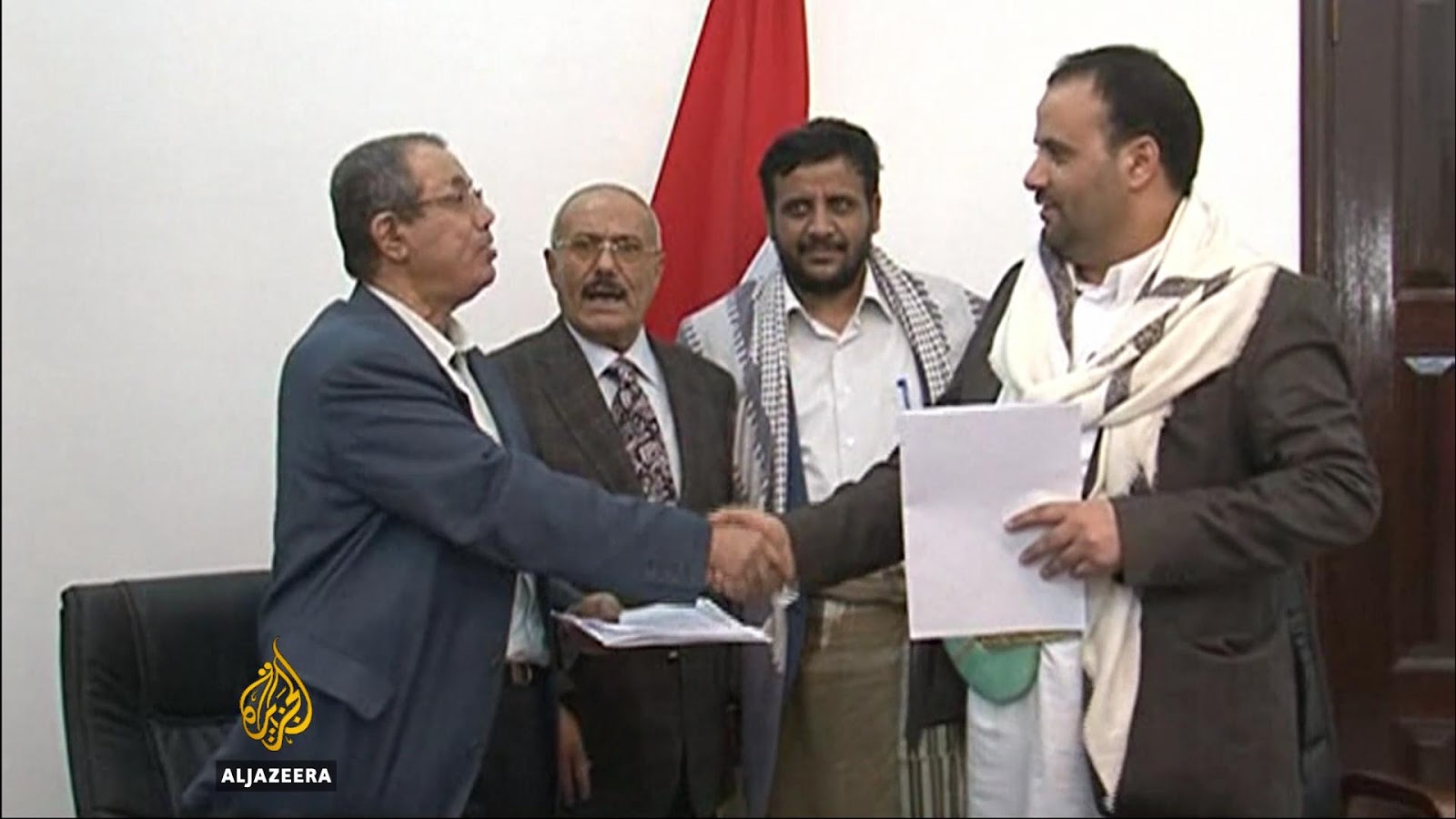
Although the GCC agreement was signed in Riyadh almost three months ago, most people have never seen a full text of the document, or of the implementation mechanism that was signed with it. Newspapers have only published quotations or summaries. Thanks to our friend in San`a, Abdulaziz al-Sakkaf, we’re able to finally publish here the official English translation of the Implementation Mechanism. I plan to provide some commentary on this at some point, but for now, the document is here for all to read.
Translated from Arabic
In the name of God, the Merciful, the Compassionate
Agreement on the implementation mechanism for the transition process in Yemen in
accordance with the initiative of the Gulf Cooperation Council (GCC)
Contents:
Part I. Introduction
Part II. The transition period
Part III. First phase of the transition
Part IV. Second phase of the transfer of power
Part V . Settlement of disputes
Part VI. Concluding provisions
Annex: Draft Presidential Decree
Part I. Introduction
1. The two parties recognize that
(a) As a result of the deadlock in the political transition, the political, economic,
humanitarian and security situation has deteriorated with increasing rapidity and the
Yemeni people have suffered great hardship;
(b) Our people, including youth, have legitimate aspirations for change; and
(c) This situation requires that all political leaders should fulfil their responsibilities towards
the people by immediately engaging in a clear process for transition to good democratic
governance in Yemen.
2. The two parties deeply appreciate the efforts of the Gulf Cooperation Council (GCC) and its
Secretary-General, the United Nations Secretary General acting through his Special Adviser,
the ambassadors of the five permanent members of the Security Council, and those of the
GCC and the European Union, to support an agreement on the peaceful transfer of power.
The two parties adopt this Mechanism on the basis of the GCC initiative and fully in
accordance with United Nations Security Council resolution 2014 (2011).
3. The following definitions shall apply in relation to this Agreement:
(a) The term “GCC Initiative” refers to the GCC initiative to resolve the Yemeni crisis in the
draft of 21 and 22 May 2011;
(b) The term “the Mechanism” refers to this Agreement on the implementation mechanism
for the transition process in Yemen in accordance with the GCC Initiative;
(c) The term “the two parties” refers to the National Coalition (General People’s Congress
and its allies) as one party, and the National Council (Joint Meeting Parties their
partners) as the other.
4. The GCC Initiative and the Mechanism shall supersede any current constitutional or legal
arrangements. They may not be challenged before the institutions of the State.
Part II. The transition period
5. The two parties acknowledge that under Presidential Decree No. 24 of 2011, the President of
Yemen irrevocably delegated to the Vice-President the presidential powers to negotiate, sign
and bring into force this Mechanism, along with all constitutional powers pertaining to its
implementation and follow-up. Those powers include calling for early elections and taking
all of the decisions necessary to form a government of national unity, including swearing in
its members, as well as establishing the other bodies set forth in this Mechanism.
6. The transition period shall enter into effect as follows:
(a) In accordance with United Nations Security Council resolution 2014 (2011), which notes
the commitment by the President of Yemen to immediately sign the GCC Initiative and
encourages him, or those authorized to act on his behalf, to do so, and to implement a
political settlement based upon it, and in accordance with Presidential Decree No. 24 of
2011, the President or the Vice-President acting on his behalf shall sign the GCC
Initiative concurrently with the signature of this Mechanism by the two parties.
(b) Concurrently with the signing of this Mechanism, and acting under the powers delegated
by the President in Presidential Decree No. 24 of 2011, the Vice-President shall issue a
decree providing for early presidential elections to be held within 90 days of the entry
into force of this Mechanism. In accordance with the relevant provisions of the
Constitution, the decree shall enter into force 60 days before the elections. The draft text
of the Decree is annexed to this Mechanism (Annex 1).
(c) This Mechanism shall enter into force when the President or Vice-President has signed
the GCC Initiative, all parties have signed this Mechanism in accordance with this
paragraph, and the decree referred to in subparagraph (b) above has been issued.
7. The transition period shall begin with the entry into force of this Mechanism. The transition period shall then consist of two phases:
(a) The first phase shall begin with the entry into force of this Mechanism and end with the inauguration of the President following the early presidential elections;
(b) The second phase, which shall last for two years, shall begin with the inauguration of the President following the early presidential elections. It shall end with the holding of
general elections in accordance with the new Constitution and the inauguration of the
new President of the Republic.
8. During the first and second stages of the transition, decisions of Parliament shall be taken by consensus. If consensus on any given topic cannot be reached, the Speaker of Parliament shall refer the matter for decision by the Vice-President in the first phase, or the President in the second phase. That decision shall be binding for the two parties.
9. The two parties shall take the necessary steps to ensure that Parliament adopts the legislation and other laws necessary for the full implementation of commitments in respect of the guarantees set forth in the GCC Initiative and this Mechanism.
Part III. First phase of the transitional period
Formation of the government of national unity
10. Immediately on entry into force of the GCC Initiative and the Mechanism, the opposition
shall nominate its candidate for the post of Prime Minister. The Vice-President shall issue a
presidential decree requesting that person to form a government of national unity. The
government of national unity shall be formed within 14 days of the issuance of the decree. A
republican decree shall be issued to that effect and signed by the Vice-President and Prime
Minister;
(a) Each party shall account for 50 per cent of nominees for the government of national unity,
and due consideration shall be given to the representation of women. With regard to the
distribution of portfolios, one of the two parties shall prepare two lists of ministries and
transmit them to the other party, which shall have the right to choose one of the lists.
(b) The Prime Minister-designate shall appoint the members of the government as proposed by
the two parties. The Vice-President shall then issue a decree setting forth the agreed names
of the cabinet members. Nominees shall have a high standard of accountability and
commitment to human rights and international humanitarian law.
11. The members of the government shall take the constitutional oath before the Vice-President.
Within ten days, the government of national unity shall submit its programme to Parliament
for a vote of confidence within five days.
Functioning of the government of national unity
12. The government of national unity shall take its decisions by consensus. If there is no full
consensus on any given matter, the Prime Minister shall consult with the Vice-President or,
after the early presidential elections, the President, in order to reach consensus. If consensus
between them is not possible, the Vice-President or, after the early presidential elections, the
President, shall take the final decision.
13. Immediately after its formation, the government of national unity shall
(a) Take the necessary steps, in consultation with the other relevant actors, to ensure the
cessation of all forms of violence and violations of humanitarian law; end the
confrontation of armed forces, armed formations, militias and other armed groups;
ensure their return to barracks; ensure freedom of movement for all through the country;
protect civilians; and take the other necessary measures to achieve peace and security
and extend State control;
(b) Facilitate and secure humanitarian access and delivery wherever it is needed;
(c) Issue appropriate legal and administrative instructions for all branches of the State sector
to comply immediately with standards of good governance, the rule of law and respect
for human rights;
(d) Issue specific legal and administrative instructions to the Office of the Public Prosecutor,
the police, prisons and security forces to act in accordance with the law and international
standards, and to release those unlawfully detained;
(e) The government of national unity shall comply with all resolutions of the Security
Council and Human Rights Council and with the relevant international norms and
conventions.
Powers of the Vice-President and government of national unity
14. In implementing this Mechanism, the Vice-President shall exercise the following
constitutional powers, in addition to those appertaining to his office:
(1) Convening early presidential elections;
(2) Exercising all functions of the President in respect of Parliament;
(3) Announcing the formation of, and swearing in, the government of national unity in the
first phase;
(4) All functions relating to the work of the Committee on Military Affairs for Achieving
Security and Stability;
(5) Managing foreign affairs to the extent necessary for the implementation of this
Mechanism;
(6) Issuing the decrees necessary for the implementation of this Mechanism.
15. In the first phase, the Vice-President and government of national unity shall exercise
executive authority encompassing all matters pertaining to this Agreement, including the
following, acting in conjunction with Parliament where appropriate:
(a) Formulating and implementing an initial programme of economic stabilization and
development and addressing the immediate needs of the population in all regions of
Yemen;
(b) Coordinating relations with development donors;
(c) Ensuring that governmental functions, including local government, are fulfilled in an
orderly manner in accordance with the principles of good governance, rule of law,
human rights, transparency and accountability;
(d) Approving an interim budget, supervising the administration of all aspects of State
finance and ensuring full transparency and accountability;
(e) Taking the necessary legislative and administrative steps to ensure that presidential
elections are held within 90 days of the entry into force of this Mechanism;
(f) Establishing the following institutions as provided for by this Mechanism:
(1) Committee on Military Affairs for Achieving Security and Stability;
(2) Conference for National Dialogue.
(g) The government of national unity and the Vice-President shall immediately establish a
liaison committee to engage effectively with youth movements from all parties in the
squares and elsewhere in Yemen, to disseminate and explain the terms of this Agreement;
initiate an open conversation about the future of the country, which will be continued
through the comprehensive Conference for National Dialogue; and involve youth in
determining the future of political life.
Committee on Military Affairs for Achieving Security and Stability
16. Within five days of the entry into force of the GCC Initiative and the Mechanism, the Vice-
President in the first transitional phase shall establish and chair a Committee on Military
Affairs for Achieving Security and Stability. The Committee shall work to
(a) End the division in the armed forces and address its causes;
(b) End all of the armed conflicts;
(c) Ensure that the armed forces and other armed formations return to their camps; end all
armed presence in the capital Sana’a and other the cities; and remove militias and
irregular armed groups from the capital and other cities;
(d) Remove road blocks, checkpoints and improvised fortifications in all governorates;
(e) Rehabilitate those who do not meet the conditions for service in the military and security
forces;
(f) Take any other measures to reduce the risk of armed confrontation in Yemen.
17. During the two transitional phases, the Committee on Military Affairs for Achieving
Security and Stability shall also work to create the necessary conditions and take the
necessary steps to integrate the armed forces under unified, national and professional
leadership in the context of the rule of law.
Early presidential elections
18.(*) The early presidential elections shall be held in accordance with the following provisions:
(*) Translator’s note: this paragraph is mis-numbered 20 in the original Arabic text.
(a) The elections shall take place within 90 days of the signature of the GCC Initiative
and the Mechanism;
(b) The early elections for the post of President shall be organized and supervised by the
Higher Commission for Elections and Referendums using the current register of
voters on an exceptional basis. Any citizen, male or female, who has attained the
legal age for voting and can establish as much on the basis of an official document
such as a birth certificate or national identity card, shall have the right to vote on the
basis of that document;
(c) The sides commit not to nominate or endorse any candidate for the early presidential
elections except for the consensus candidate Vice-President Abd Rabbuh Mansur
Hadi;
(d) The Secretary-General of the United Nations is requested to provide and coordinate
electoral assistance to help ensure the orderly and timely holding of elections.
Part IV. Second phase of the transfer of power
Functions and powers of the President and government of national unity
19.(†) After the early Presidential elections, the newly elected President and the Government of
national unity shall exercise all of their customary functions as set forth in the Constitution.
In addition, they shall exercise the powers necessary to continue the tasks specified for the
implementation of the first phase, and additional tasks specified for the second phase of the
transfer of power. The latter include
(†) Translator’s note: this paragraph is mis-numbered 21 in the original Arabic text.
(a) Ensuring that the Conference for National Dialogue is convened, and forming a
preparatory committee for the Conference, as well as an Interpretation Committee and
other bodies established pursuant to this Mechanism;
(b) Establishing a process of constitutional reform that will address the structure of the State
and the political system, and submitting the amended Constitution to the Yemeni people
in a referendum;
(c) Reforming the electoral system; and
(d) Holding elections for Parliament and the Presidency in accordance with the new
Constitution.
Conference for National Dialogue
20.(‡) With the beginning of the second transitional phase, the President-elect and the government
of national unity shall convene a comprehensive Conference for National Dialogue for all
forces and political actors, including youth, the Southern Movement, the Houthis, other
political parties, civil society representatives and women. Women must be represented in
all participating groups.
(‡) Translator’s note: this paragraph is mis-numbered 18 in the original Arabic text.
21.(§)The Conference shall discuss the following issues:
(§) Translator’s note: this paragraph is mis-numbered 19 in the original Arabic text.
(a) The process of drafting the Constitution, including the establishment of a
Constitutional Drafting Commission and its membership;
(b) Constitutional reform, addressing the structure of the State and political system, and
submitting constitutional amendments to the Yemeni people through a referendum;
(c) The dialogue shall address the issue of the South in a manner conducive to a just
national solution that preserves the unity, stability and security of Yemen.
(d) Examination of the various issues with a national dimension, including the causes of
tension in Saada;
(e) Taking steps towards building a comprehensive democratic system, including reform
of the civil service, the judiciary and local governance;
(f) Taking steps aimed at achieving national reconciliation and transitional justice, and
measures to ensure that violations of human rights and humanitarian law do not
occur in future;
(g) The adoption of legal and other means to strengthen the protection and rights of
vulnerable groups, including children, as well as the advancement of women;
(h) Contributing to determining the priorities of programmes for reconstruction and
sustainable economic development in order to create job opportunities and better
economic, social and cultural services for all.
Constitutional Commission
22. The government of national unity shall establish a Constitutional Commission immediately
on the conclusion of the work of the Conference of National Dialogue within six months.
The Commission shall prepare a new draft constitution within three months of the date of its
establishment. It shall propose the necessary steps for the draft constitution to be discussed
and submitted for referendum in order to ensure broad popular participation and
transparency.
Organization of elections under the new Constitution
23. Within three months of the adoption of the new Constitution, Parliament shall enact a law
convening national parliamentary elections and, if provided for by the Constitution,
presidential elections. The Higher Commission for Elections and Referendums shall be
reconstituted and the new register of voters re-compiled in accordance with the new
Constitution. That law will be subject to subsequent review by the newly elected Parliament.
24. The term of the President elected under paragraph 7 of this Mechanism shall end upon the
inauguration of the President elected under the new Constitution.
Part V. Settlement of disputes
25. Within 15 days of the entry into force of the GCC Initiative and the Mechanism, the Vice-
President and the Prime Minister of the government of national unity shall form an
Interpretation Committee to which the two parties shall refer in order to resolve any dispute
regarding the interpretation of the GCC Initiative or the Mechanism.
Part VI. Concluding provisions
26. Women shall appropriately represented in all of the institutions referred to in this
Mechanism.
27. The Government shall provide adequate funding for the institutions and activities
established by this Mechanism.
28. In order to ensure the effective implementation of this Mechanism, the two parties call on
the States members of the GCC and the United Nations Security Council to support its
implementation. They further call on the States members of the GCC, the permanent
members of the Security Council, the European Union and its States members to support the
implementation of the GCC Initiative and the Mechanism.
29. The Secretary-General of the United Nations is called upon to provide continuous
assistance, in cooperation with other agencies, for the implementation of this Agreement. He
is also requested to coordinate assistance from the international community for the
implementation of the GCC Initiative and the Mechanism.
30. The following are invited to attend the signature of this Mechanism: the Secretary-General
of the GCC and the Secretary-General of the United Nations or their representatives, as well
as the representatives of the States members of the GCC, the permanent members of the
United Nations Security Council, the European Union and the League of Arab States.
(Signatures and dates)
Annex
Exercising(**) the authority conferred on me by the President under Presidential Decree No. 24 of
2011, I hereby solemnly convene elections for the office of President of the Republic to be held on
00/00/2012. This Decree is deemed to be in force from today, and the convening of elections
contained therein is irrevocable. The convening of elections shall take effect in accordance with the
provisions of the Mechanism, without any need for any further steps, sixty days before the holding
of elections as set forth in the Mechanism.
** Translator’s note: On the basis of the unofficial English translation, the following may be missing from the Arabic
text:
” Annex: Decree issued by the Vice-President concurrently with the signature of the GCC Initiative and the Mechanism.
The Vice-President of the Republic, acting under to the authority conferred on him by the President under Presidential
Decree No. 24 of 2011.”
This decree shall be published in the Official Gazette.




Although the GCC agreement was signed in Riyadh almost three months ago, most people have never seen a full text of the document, or of the implementation mechanism that was signed with it. Newspapers have only published quotations or summaries. Thanks to our friend in San`a, Abdulaziz al-Sakkaf, we’re able to finally publish here the official English translation of the Implementation Mechanism. I plan to provide some commentary on this at some point, but for now, the document is here for all to read.
accordance with the initiative of the Gulf Cooperation Council (GCC)
humanitarian and security situation has deteriorated with increasing rapidity and the
Yemeni people have suffered great hardship;
the people by immediately engaging in a clear process for transition to good democratic
governance in Yemen.
Secretary-General, the United Nations Secretary General acting through his Special Adviser,
the ambassadors of the five permanent members of the Security Council, and those of the
GCC and the European Union, to support an agreement on the peaceful transfer of power.
The two parties adopt this Mechanism on the basis of the GCC initiative and fully in
accordance with United Nations Security Council resolution 2014 (2011).
draft of 21 and 22 May 2011;
for the transition process in Yemen in accordance with the GCC Initiative;
and its allies) as one party, and the National Council (Joint Meeting Parties their
partners) as the other.
arrangements. They may not be challenged before the institutions of the State.
Yemen irrevocably delegated to the Vice-President the presidential powers to negotiate, sign
and bring into force this Mechanism, along with all constitutional powers pertaining to its
implementation and follow-up. Those powers include calling for early elections and taking
all of the decisions necessary to form a government of national unity, including swearing in
its members, as well as establishing the other bodies set forth in this Mechanism.
the commitment by the President of Yemen to immediately sign the GCC Initiative and
encourages him, or those authorized to act on his behalf, to do so, and to implement a
political settlement based upon it, and in accordance with Presidential Decree No. 24 of
2011, the President or the Vice-President acting on his behalf shall sign the GCC
Initiative concurrently with the signature of this Mechanism by the two parties.
by the President in Presidential Decree No. 24 of 2011, the Vice-President shall issue a
decree providing for early presidential elections to be held within 90 days of the entry
into force of this Mechanism. In accordance with the relevant provisions of the
Constitution, the decree shall enter into force 60 days before the elections. The draft text
of the Decree is annexed to this Mechanism (Annex 1).
the GCC Initiative, all parties have signed this Mechanism in accordance with this
paragraph, and the decree referred to in subparagraph (b) above has been issued.
general elections in accordance with the new Constitution and the inauguration of the
new President of the Republic.
shall nominate its candidate for the post of Prime Minister. The Vice-President shall issue a
presidential decree requesting that person to form a government of national unity. The
government of national unity shall be formed within 14 days of the issuance of the decree. A
republican decree shall be issued to that effect and signed by the Vice-President and Prime
Minister;
and due consideration shall be given to the representation of women. With regard to the
distribution of portfolios, one of the two parties shall prepare two lists of ministries and
transmit them to the other party, which shall have the right to choose one of the lists.
the two parties. The Vice-President shall then issue a decree setting forth the agreed names
of the cabinet members. Nominees shall have a high standard of accountability and
commitment to human rights and international humanitarian law.
Within ten days, the government of national unity shall submit its programme to Parliament
for a vote of confidence within five days.
consensus on any given matter, the Prime Minister shall consult with the Vice-President or,
after the early presidential elections, the President, in order to reach consensus. If consensus
between them is not possible, the Vice-President or, after the early presidential elections, the
President, shall take the final decision.
cessation of all forms of violence and violations of humanitarian law; end the
confrontation of armed forces, armed formations, militias and other armed groups;
ensure their return to barracks; ensure freedom of movement for all through the country;
protect civilians; and take the other necessary measures to achieve peace and security
and extend State control;
to comply immediately with standards of good governance, the rule of law and respect
for human rights;
the police, prisons and security forces to act in accordance with the law and international
standards, and to release those unlawfully detained;
Council and Human Rights Council and with the relevant international norms and
conventions.
constitutional powers, in addition to those appertaining to his office:
(2) Exercising all functions of the President in respect of Parliament;
(3) Announcing the formation of, and swearing in, the government of national unity in the
first phase;
(4) All functions relating to the work of the Committee on Military Affairs for Achieving
Security and Stability;
(5) Managing foreign affairs to the extent necessary for the implementation of this
Mechanism;
(6) Issuing the decrees necessary for the implementation of this Mechanism.
executive authority encompassing all matters pertaining to this Agreement, including the
following, acting in conjunction with Parliament where appropriate:
development and addressing the immediate needs of the population in all regions of
Yemen;
orderly manner in accordance with the principles of good governance, rule of law,
human rights, transparency and accountability;
finance and ensuring full transparency and accountability;
elections are held within 90 days of the entry into force of this Mechanism;
liaison committee to engage effectively with youth movements from all parties in the
squares and elsewhere in Yemen, to disseminate and explain the terms of this Agreement;
initiate an open conversation about the future of the country, which will be continued
through the comprehensive Conference for National Dialogue; and involve youth in
determining the future of political life.
President in the first transitional phase shall establish and chair a Committee on Military
Affairs for Achieving Security and Stability. The Committee shall work to
armed presence in the capital Sana’a and other the cities; and remove militias and
irregular armed groups from the capital and other cities;
forces;
Security and Stability shall also work to create the necessary conditions and take the
necessary steps to integrate the armed forces under unified, national and professional
leadership in the context of the rule of law.
and the Mechanism;
Higher Commission for Elections and Referendums using the current register of
voters on an exceptional basis. Any citizen, male or female, who has attained the
legal age for voting and can establish as much on the basis of an official document
such as a birth certificate or national identity card, shall have the right to vote on the
basis of that document;
elections except for the consensus candidate Vice-President Abd Rabbuh Mansur
Hadi;
electoral assistance to help ensure the orderly and timely holding of elections.
national unity shall exercise all of their customary functions as set forth in the Constitution.
In addition, they shall exercise the powers necessary to continue the tasks specified for the
implementation of the first phase, and additional tasks specified for the second phase of the
transfer of power. The latter include
preparatory committee for the Conference, as well as an Interpretation Committee and
other bodies established pursuant to this Mechanism;
and the political system, and submitting the amended Constitution to the Yemeni people
in a referendum;
Constitution.
of national unity shall convene a comprehensive Conference for National Dialogue for all
forces and political actors, including youth, the Southern Movement, the Houthis, other
political parties, civil society representatives and women. Women must be represented in
all participating groups.
Constitutional Drafting Commission and its membership;
submitting constitutional amendments to the Yemeni people through a referendum;
national solution that preserves the unity, stability and security of Yemen.
tension in Saada;
of the civil service, the judiciary and local governance;
measures to ensure that violations of human rights and humanitarian law do not
occur in future;
vulnerable groups, including children, as well as the advancement of women;
sustainable economic development in order to create job opportunities and better
economic, social and cultural services for all.
on the conclusion of the work of the Conference of National Dialogue within six months.
The Commission shall prepare a new draft constitution within three months of the date of its
establishment. It shall propose the necessary steps for the draft constitution to be discussed
and submitted for referendum in order to ensure broad popular participation and
transparency.
convening national parliamentary elections and, if provided for by the Constitution,
presidential elections. The Higher Commission for Elections and Referendums shall be
reconstituted and the new register of voters re-compiled in accordance with the new
Constitution. That law will be subject to subsequent review by the newly elected Parliament.
inauguration of the President elected under the new Constitution.
President and the Prime Minister of the government of national unity shall form an
Interpretation Committee to which the two parties shall refer in order to resolve any dispute
regarding the interpretation of the GCC Initiative or the Mechanism.
Mechanism.
established by this Mechanism.
the States members of the GCC and the United Nations Security Council to support its
implementation. They further call on the States members of the GCC, the permanent
members of the Security Council, the European Union and its States members to support the
implementation of the GCC Initiative and the Mechanism.
assistance, in cooperation with other agencies, for the implementation of this Agreement. He
is also requested to coordinate assistance from the international community for the
implementation of the GCC Initiative and the Mechanism.
of the GCC and the Secretary-General of the United Nations or their representatives, as well
as the representatives of the States members of the GCC, the permanent members of the
United Nations Security Council, the European Union and the League of Arab States.
2011, I hereby solemnly convene elections for the office of President of the Republic to be held on
00/00/2012. This Decree is deemed to be in force from today, and the convening of elections
contained therein is irrevocable. The convening of elections shall take effect in accordance with the
provisions of the Mechanism, without any need for any further steps, sixty days before the holding
of elections as set forth in the Mechanism.
text:
Decree No. 24 of 2011.”